Bitpanda logo

12/15/2025

7 min read

What is a stock?

What Is A Stock Personal Finance 11 Bitpanda Academy

Stocks represent fractional ownership in a publicly traded company and are generally considered a medium- to long-term investment option for building wealth. In this article, we’ll explain what stocks are, the different types that exist, and the key advantages and disadvantages of investing in them. You’ll also learn what to consider when buying stocks to make a well-informed start in the stock market

  • Definition: Stocks are securities that represent ownership in a company. Shareholders typically receive voting rights and may be entitled to a share ("stock") of the company’s profits, usually distributed as dividends.

  • Types of stocks: Common types include ordinary stocks, preference stocks, and no-par-value sstocks. These differ in the rights they grant shareholders, how easily they can be transferred, and how they are listed on the stock market.

  • Return: If a company grows in value through successful business performance, its stock price may rise as well. This allows investors to earn a return when the value of their stock increases or through dividend payments.

  • Advantages and disadvantages: Stocks provide an opportunity to build wealth over the long term but also come with risks. Investors can incur losses, especially if stocks are sold during market downturns or if the company becomes insolvent.

What is a stock?

A stock is a security that represents a portion of a company’s share capital. By purchasing stocks, investors become co-owners or shareholders of the company. Depending on the company’s structure, shareholders may receive voting rights at the annual general meeting and may be entitled to a share of the company’s profits in the form of dividends. Many investors buy stocks with the aim of participating in the company’s growth, benefiting from a rising stock price, and building long-term wealth.

Companies issue stocks in order to raise capital. By selling shares to the public, companies obtain equity that can be used for investments, expansion, or other strategic initiatives. This creates a mutually beneficial relationship, since investors have the opportunity to earn returns and the company gains access to funding.

Investors can profit from stocks in two primary ways:

  • Capital gains: selling a stock at a higher price than it was purchased for

  • Dividends: profit distributions decided at the annual general meeting if the company chooses to pay them

Companies that issue stocks typically take the legal form of a public limited company (AG) or a partnership limited by shares (KGaA). European corporate structures such as Societas Europaea (SE), as well as international forms like the American Inc., British PLC, or the French, Spanish, and Italian SA can also issue stocks. In all cases, a company must be listed on a stock exchange in order to offer its shares to the public.

What types of stocks exist?

There are various types of stocks, and they differ in their rights, transferability, or listing. These include nominal value stocks, dividend stocks, bearer stocks, registered stocks, ordinary stocks, preference stocks, and no-par value stocks. Once you understand the characteristics of each type, you will be better equipped to decide which stocks you can invest in and which ones suit your investment strategy and portfolio.

Nominal value stocks

Nominal value stocks have a fixed monetary value, which is usually one euro per stock. This allows companies to issue a particularly large number of stocks, although this type of stock has become rare.

It is important to note that the nominal value of a stock does not match its market value, which is the stock price. Since the market value is determined by supply and demand, it can differ significantly from the nominal value.

The proportion of a company’s share capital represented by one stock is calculated by comparing its nominal value to the company’s total share capital. This proportion usually accounts for only a small fraction of the overall capital.

There is also a legal restriction to consider. Nominal value stocks cannot be issued below their nominal value, although they may be sold at a higher price. During a capital increase, for example, the nominal value may be lower than the issue price, since the issue price can reflect the current market price.

Dividend stocks

Dividend stocks are stocks that distribute dividends or profits to their shareholders. Whether dividends are paid, and in what amount, is decided at the annual general meeting of the public limited company. Dividend payments are usually made a few days after the AGM and are distributed as a fixed amount per stock.

Small cap

Small caps refer to stocks of smaller publicly listed companies with lower market capitalisation (market cap). There is no universal threshold for what qualifies as a small cap, and definitions can vary depending on the market or index provider.

Smaller companies often have greater growth potential than larger, more established firms, which means small caps may offer the possibility of higher returns. At the same time, they tend to be more volatile. Investors therefore have the chance of above-average gains, but they also face a higher risk of significant losses.

Mid cap

Mid caps are stocks of companies with medium market capitalisation. They sit between small caps and large caps, and they generally represent companies that are more stable than small caps but still offer more growth potential than large caps.

There is no fixed definition for the market cap range that qualifies as a mid cap, since the thresholds can vary by region and by index provider.

Large cap

Large caps refer to stocks of large, established companies with high market capitalisation. These companies are often considered relatively stable and are typically better positioned to withstand economic downturns, which makes their stock prices less volatile.

Due to their size and high market capitalisation, large companies often have lower growth potential compared to small and mid-sized firms.

Many large companies distribute regular dividends, which can make large-cap stocks appealing to investors who seek a source of passive income.

Bearer stocks

Bearer stocks are securities that certify ownership in a company. This ownership entitles the holder (or bearer) to certain rights, such as voting at the annual general meeting. Because the shareholder’s identity is not recorded in the stock register, bearer stocks can be transferred very easily, for example through a sale on the stock exchange.

Although bearer stocks were once the most common form in Germany, many companies today choose to issue registered stocks instead. This allows companies to know who holds their shares and maintain an up-to-date shareholder register.

Registered stocks

Registered stocks are issued in the name of the shareholder, which allows the company to know who holds a stake. When purchasing this type of stock, the shareholder must be entered into the company’s stock register.

Because the shareholder is known to the company, communication is generally easier, for example when sending invitations to the annual general meeting or sharing other company news. For shareholders, transferring registered stocks requires a written transfer declaration. In some cases, additional company approval is needed, which can make selling these stocks more difficult.

Common stocks

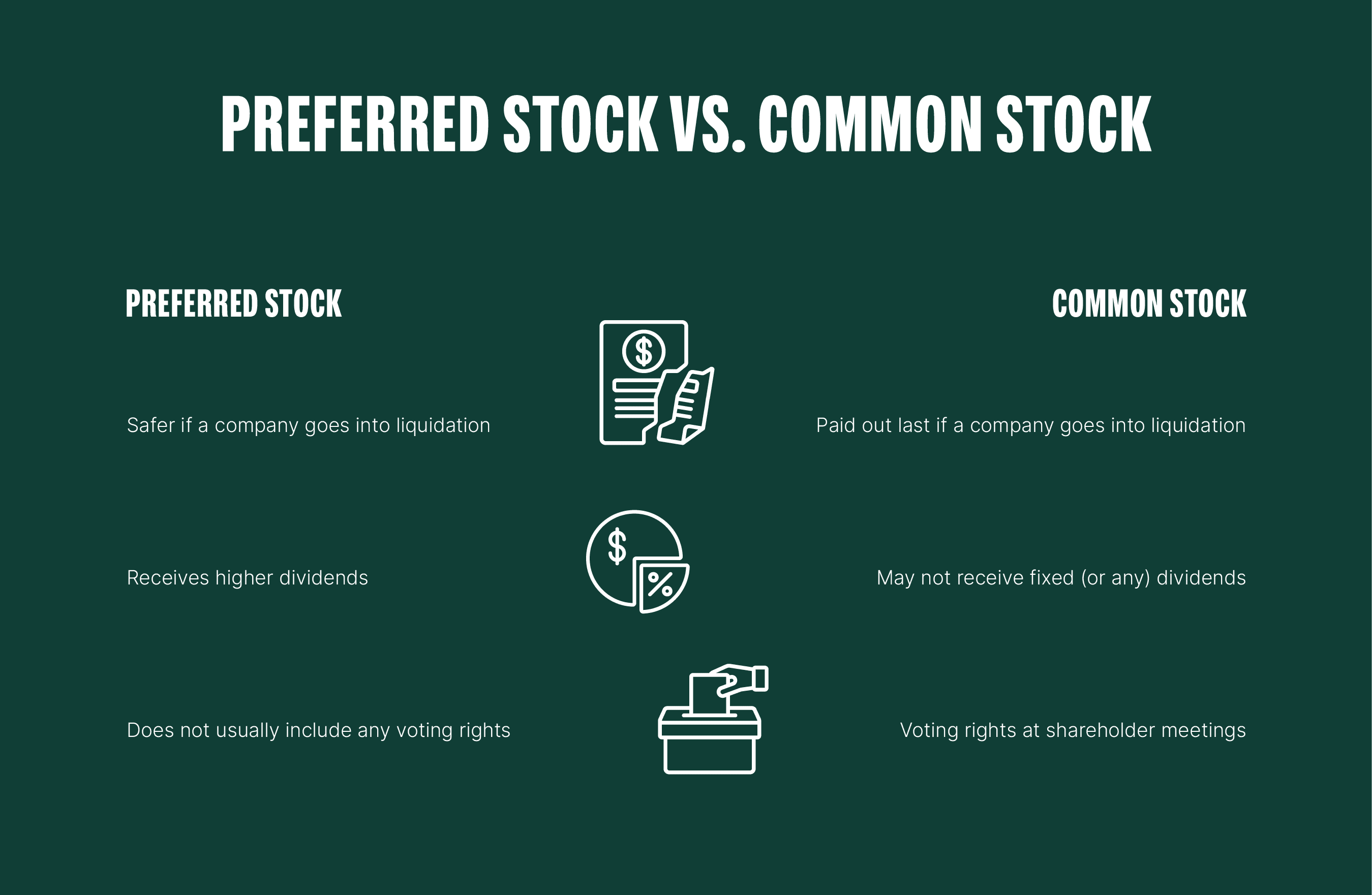
As the holder of a common stock, you usually have the right to vote at the annual general meeting on matters related to the company’s development. Shareholders may also receive dividends, although dividend payments are not guaranteed and the amounts can vary.

If the company goes bankrupt, holders of common stocks may only claim their invested capital after creditors, bondholders, and preference shareholders have been paid.

This introduces a certain level of risk. However, common stocks have historically delivered higher long-term returns than preferred stocks and bonds.

Preferred stocks

Unlike ordinary stocks, preferred stocks do not grant voting rights on company matters. However, the shareholders have priority over ordinary shareholders in the event of bankruptcy. For companies, issuing preferred stocks is a way to raise equity while maintaining control, since these shareholders do not participate in voting.

Preferred shareholders typically receive fixed or predetermined dividends, and these are paid out before dividends to ordinary shareholders. This makes preference stocks appealing to investors who value stability and seek a potentially steady source of future cash flow.

No-par value stocks

No-par value stocks do not carry a fixed nominal amount. Instead, each share represents an equal fractional ownership of the company’s total share capital. The notional value of a no-par value stock is determined by dividing the company’s total share capital by the number of issued shares, and this calculated value must not be less than one euro.

Unlike par-value shares, the stock certificate for a no-par value stock does not display a specific amount. It is simply designated as “one share.”

Stocks vs. derivatives: what’s the difference?

While stocks represent an ownership interest in a company, derivatives derive their value from underlying assets such as stocks. When you buy a stock, you become a co-owner of the company. When you trade derivatives, you are only speculating on price movements and do not actually own the underlying stocks.

Other important differences between stocks and derivatives ar:

  • Stocks can increase in value and generate dividends, but they can also lead to losses. Derivatives, on the other hand, use leverage, which means they can potentially generate higher profits but also greater losses. Because a total loss is possible with derivatives, they carry a higher risk than stocks.

  • Stocks are generally considered a long-term investment. Derivatives, however, are often used to speculate on rising or falling prices and are therefore frequently used for short-term strategies.

  • The mechanics of stocks are relatively easy to understand. Derivatives are more complex and carry greater risks, which is why investors should have a higher level of expertise before investing in them.

Even though derivatives can yield higher profits, stocks offer the possibility of passive income through ownership in a company and generally carry a lower level of risk. This makes them particularly attractive for investors with long-term goals.

How does a stock increase in value?

The value of a stock depends on developments in the stock market, which are driven by supply and demand. A stock increases in value when more people are buying than selling, meaning demand is higher than supply. Conversely, the stock price falls when supply exceeds demand.

How much profit a stock can generate depends on the amount invested and on the stock’s performance. Compared to more diversified investment options such as ETFs or funds, investing in individual stocks is considered riskier, but it also offers greater long-term return potential. Investors earn money with stocks by selling them for a higher price than they originally paid.

Dividends provide another way to earn income from stocks. Some companies distribute dividends quarterly or monthly, while others do not pay dividends at all.

In summary, the profitability of stocks depends on their potential for a profitable sale or on dividend payments.

How can you buy and trade stocks?

Investing in the stock market is straightforward and can be done in just a few steps. You can buy stocks through a bank or an online broker, allowing you to gradually build wealth. What matters most is that your entry into the stock market is well planned and guided by a clear goal.

Here are the key steps to buying your first stocks:

1. Set goals:  Define your financial goals and your investment time frame. For example, consider whether you want to build long-term wealth or save for retirement.

2. Understand stocks: Make sure you understand what stocks are, the different types that exist, and what factors you should pay attention to before investing.

3. Open a brokerage account:  If you want to buy and trade stocks through a bank, you will need a securities account. On Bitpanda, all you need is a user account to buy and trade stocks.

4. Choose stocks: Focus on quality, the company’s business model, financial stability, and future potential. Ask yourself which stocks best match your investment strategy.

5. Buy and monitor: Purchase the stocks you have selected and monitor their performance over the long term. Try to avoid reacting impulsively to short-term market fluctuations.

New to Bitpanda? Register your account today!

Sign up here

Advantages and disadvantages of stocks

Every type of investment carries risks, but it also offers opportunities. The same applies to stocks. This is why you should first familiarise yourself with the advantages and disadvantages of stocks before investing your money.

Advantages of stocks

  • Attractive return potential: Over the long term, stocks can offer return opportunities through profits and dividends.

  • Dividends: Some stocks pay dividends that are directly tied to the company’s performance.

  • Liquidity: Since stocks can be bought and sold on trading days, your invested capital is accessible during those exchange hours.

  • Diversification: By purchasing multiple stocks across industries, countries and company sizes, investors can diversify their portfolios and thus spread risk.

  • Voting rights: With many stocks, shareholders receive voting rights at general meetings, allowing them to participate in decisions about the company and its success.

Disadvantages of stocks

  • Risk of loss: Stock prices are subject to strong fluctuations, making short-term losses possible; in the worst case, if a company becomes insolvent, this can lead to a total loss of the invested capital.

  • Uncertain returns: Profits depend on business performance and external factors, meaning returns are not guaranteed.

  • Long-term investment horizon: Stock prices fluctuate, which makes them a less suitable asset class for short-term investment horizons.

  • Emotional pressure: Those who get nervous due to price fluctuations and sell stocks impulsively may incur losses.

  • Time investment: Managing a portfolio and stocks requires regular attention to the stock market, company data and developments.

  • Limited influence: Even though shareholders have voting rights in the company, owning only a few stocks does not significantly influence company management.

What you should consider when selecting stocks

Since no single stock is suitable for every investor, it is important to compare different stocks and assess what each one offers. You should also consider whether a stock aligns with your investment strategy and your personal risk tolerance.

Here is a selection of questions you should ask yourself before choosing specific stocks:

  • How much money do I want to invest?

  • What is my risk tolerance?

  • How long can and do I want to invest my money?

  • Which industries and markets are of interest to me as an investment?

  • What is my investment goal with stocks?

  • Does the company have long-term potential?

  • Is the company financially sound?

  • How has the stock price performed so far?

  • Are dividends paid regularly?

  • What are the company’s unique selling points or competitive advantages?

  • Is the company transparent and responsible?

No matter which stocks you choose, it can be wise to invest your money in various stocks or also consider ETFs and other asset classes such as cryptocurrencies or precious metals for broader diversification. This can help minimise the risk of loss.

Conclusion: stocks as a way to build long-term wealth

With stocks, you have the opportunity to build wealth over the long term. When you buy stocks, you acquire shares in a company and can benefit from its positive development. If the company performs well, shareholders may receive distributions from its profits. Returns can also be generated by selling stocks at a higher price than the one originally paid.

Companies decide what types of stocks they offer. There are many different forms, from nominal value stocks to bearer stocks to no-par value stocks, each with different rights, listing characteristics, and transferability. To match your investment strategy, you should select the types of stocks that suit your goals and preferences.

Like any investment, stocks offer advantages but also carry risks. Alongside attractive return potential, losses are possible, and there are no guarantees for profits or dividends. For this reason, it often makes sense not to rely on a single stock, but to diversify your portfolio across different asset classes in order to spread risk more effectively.

Frequently asked questions about stocks

You now have a good overview of what stocks are. In our FAQ, you can learn even more about this topic and deepen your understanding of how stocks work.

How do I make money with stocks?

You can make money with stocks by selling them at a higher price than you bought them. Another way to build wealth with stocks is through long-term investment, where you receive regular dividends – in other words, profit distributions.

What is the difference between real stocks and derivatives?

Real stocks are shares that give investors ownership in a company. Derivatives are merely contracts whose value is derived from an underlying asset such as a stock, commodity or index. This means that holders of derivatives do not have ownership rights and do not receive dividends. Instead, derivatives can generate higher returns than stocks through leverage. However, derivatives also carry higher risks of total loss and may involve margin calls.

What are dividends and how do they work?

Dividends are company profits distributed to shareholders. If shareholders hold one or more stocks of the company on the day of the general meeting, part of the profit is paid out to them. The general meeting decides whether a dividend is paid and in what amount. Although the dividend is not directly linked to the stock price, in practice it often reflects the company’s financial health, which is usually also reflected in the stock price.

Want to expand your knowledge of real stocks? In the Bitpanda Academy, you’ll find numerous articles that help you better understand different investment opportunities. Discover more topics about securities such as stocks and learn how you can enter the stock market with ease.

Bitpanda logo
Bitpanda Technology Solutions
Get the app