


12/10/2025
12 min read
Trading Bot
Trading bots automate trading strategies and allow you to trade around the clock without the need for constant manual input. These tools are especially popular in the highly volatile crypto market, where prices can move quickly and significantly. Bots can react to these movements in real time, helping you take advantage of opportunities as they happen.
In this guide, you’ll learn what a trading bot is, how it can support your crypto or share trading and what to look out for when choosing a reputable provider. Whether you’re exploring crypto trading bots for the first time or comparing options to find the best trading bot for your needs, this guide covers all the key points to help you make an informed decision.
Definition: Trading bots are trading software programmes that make automated trading decisions based on market data and set algorithms.
Use: Bots are used across various markets, including cryptocurrencies and shares, enabling trades in volatile markets without constant manual monitoring.
Providers: Choosing a trading bot provider requires careful consideration – factors such as reliability, ease of use, trading strategies, cost structure and customisability are crucial.
Pros and cons: Trading bots offer advantages like time-saving, emotion-free trading but also involve risks and require solid risk management.
Definition: What is a trading bot?
According to the definition, a trading bot is a specialised trading software that automates the trading process and independently makes decisions based on set algorithms. Such bots can analyse market data in real time, including price movements, trading volume and market trends, and place trades automatically based on that data. This allows them to react to changes in a flash and execute trades more efficiently than human traders could.
Trading bots are especially common when dealing with cryptocurrencies, where trading happens 24/7 and prices can shift quickly. They also give less experienced traders the opportunity to follow structured strategies and potentially benefit from market movements. You can set up a trading bot to follow specific rules based on your trading goals and risk level, and use it for both crypto and share trading.
How does a trading bot work?
Trading bots use a combination of data analysis and programmed decision logic to make and execute trading decisions automatically. The auto trading approach allows the bot to remain active in the market without human input and make decisions in real time. The robot can therefore work with your money 24/7 and quickly react to market movements without the need for manual intervention. The way a trading bot functions can be broken down into the following steps:
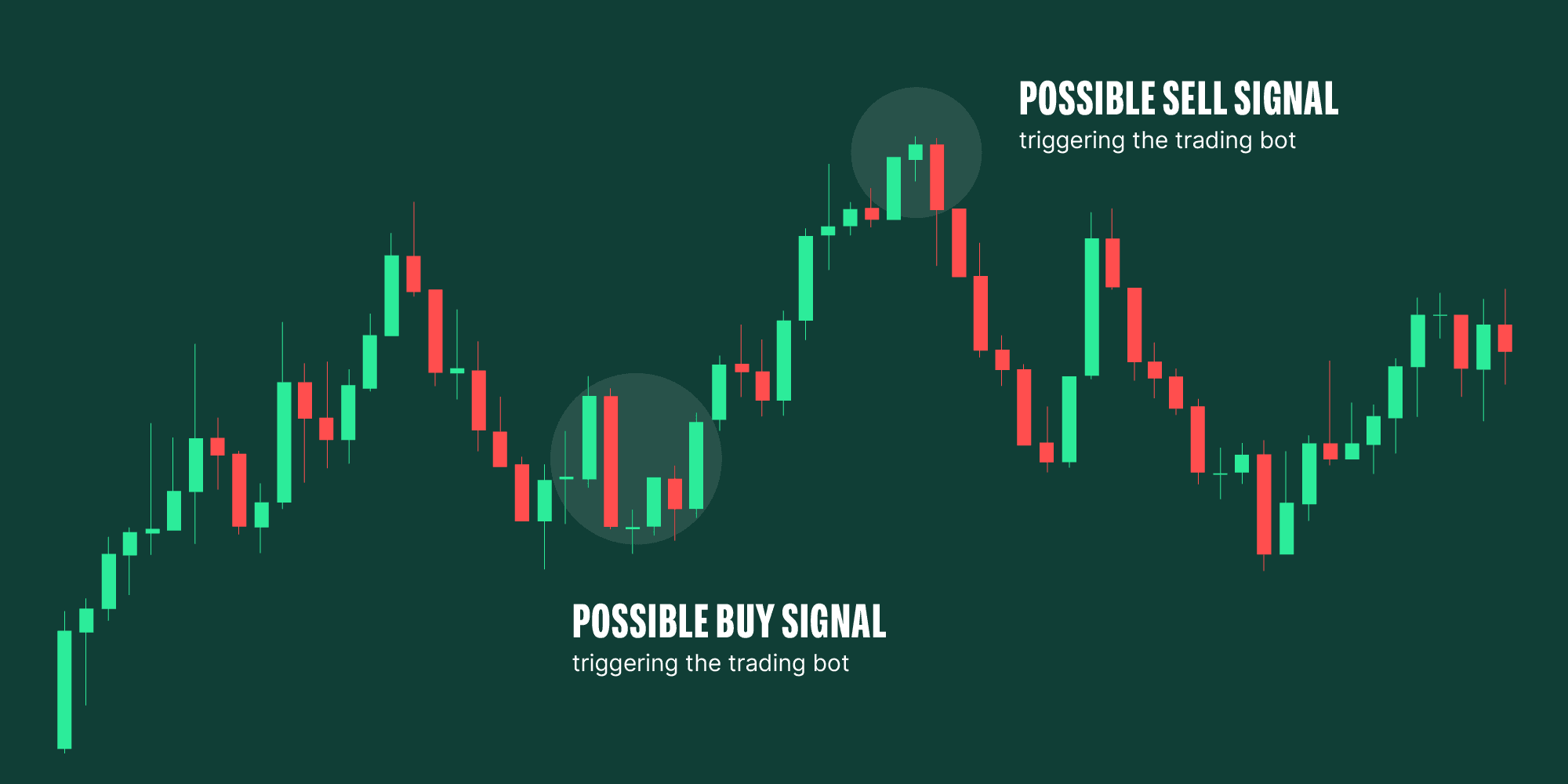
Data analysis: The trade bot continuously collects and analyses data on market conditions such as price movements, trading volume and trading signals. This data then forms the basis for the bot’s decisions.
Algorithmic decisions: It uses programmed algorithms to decide when to buy or sell. These decisions are based on predefined strategies that reflect the user’s risk appetite and profit goals.
Trade execution: Once the bot makes a decision, it carries out the trade automatically, without any manual input. This is especially useful in volatile markets like crypto, where speed can make a difference.
Customisability: Many trading bots can be customised so traders can set specific parameters such as risk levels or preferred trading strategies.
Thanks to this structured process, a trading bot can respond to market movements instantly and automate even complex trading strategies. It helps traders make the most of opportunities and manage risks effectively, even in markets that never sleep.
The pros and cons of trading bots
If you’re thinking about using trading bots to manage your money, it’s important to understand both the benefits and the risks involved.
Advantages of trading bots
Lightning-fast reactions: Trading bots react to market changes in fractions of a second, enabling quick and precise trades.
Round-the-clock trading: Bots trade continuously, even at night or on weekends, without the need for manual oversight.
No emotions: Bots trade purely based on data and avoid emotional decisions like fear or greed.
Customisable to your strategy: Whether you’re risk-taking or cautious, trading bots can be tailored to personal goals and risk profiles.
Ideal for volatile markets: Trading bots are ideal for the cryptocurrency market, which is highly volatile and often requires fast action.
Beginner-friendly: Many bots are easy to use and give newcomers access to crypto trading.
Disadvantages of trading bots
Risk during market volatility: In highly fluctuating markets, bots can act rashly and cause losses.
Regular checks needed: Even though bots trade automatically, they need careful setup and regular review.
Lack of intuition: Bots don’t have instincts or human judgement, which can be a drawback in situations where experience or market feel matters.
Technical know-how required: Bots lack instincts and human judgement, which can be a disadvantage when experience or a feel for the market would lead to better decisions.
Possible misjudgements: In extremely volatile markets like crypto, trading bots aren't immune to wrong reactions.
Challenging for advanced users: More powerful bots often have a steep learning curve and are complex to configure.
Risks and opportunities when using trading bots
Using trading bots brings both opportunities and risks. On the one hand, trading bots can achieve higher returns thanks to their automation and ability to process large volumes of data quickly. On the other hand, there are risks such as reliance on market movements, possible technical issues and the need for careful monitoring. You should understand these aspects to be able to take suitable precautions.
Losses and dependency on market trends
Trading bots can be prone to losses if they rely on market trends that change unexpectedly. A bot that’s programmed to follow a specific trend may struggle to adapt to new conditions, which can lead to losses.
Moreover, dependency on market trends can mean that the trading robot is unable to respond to changing market conditions. This poses a significant risk in the event of unexpected market swings, such as those triggered by sudden news events or flash crashes. Although some advanced bots are equipped with machine learning or adaptive algorithms to adjust to changing conditions, their effective use often demands careful configuration and continuous user oversight.
Higher returns through automation
Trading bots can achieve higher returns and profits through automation by executing trades around the clock without being influenced by human emotions like fear or greed. Additionally, bots can process large volumes of data quickly and execute trades based on predefined rules and parameters. Their ability to act continuously and rationally enables them to take advantage of opportunities that human traders might overlook.
However, the performance of a bot always depends on the quality of its programming and the strategies it uses. Trading robots can't predict the future and rely on historical data and predefined logic. Backtesting (testing the strategy using historical data) can help assess a bot’s performance under different market conditions. Efficiency in volatile markets also heavily depends on the strategy employed, such as arbitrage or scalping.
Need for monitoring and risk management
Even though trading bots offer many advantages, they don't replace the need for regular monitoring by the user. Careful review of a bot’s performance and adjustments to changing market conditions are important to minimise losses. You should use risk management methods such as stop-loss orders or diversification if you want to minimise potential losses. Users should also be aware of potential security risks like API vulnerabilities or bot hacking and take suitable protective measures.
Does a trading bot affect the performance and outcome of cryptocurrencies?
A trading bot doesn't directly alter the price movement or performance of a cryptocurrency, at least not in retail trading. Trading bots used by private individuals are tools to automate trades based on predefined rules. They use current market data, analyse patterns and execute trades accordingly. This allows users to act more efficiently, secure profits or manage risks more effectively. However, the actual price development of a crypto asset remains unaffected by this.
In professional settings, such as among institutional investors or large exchanges, far more powerful trading systems are used. These bots trade with large amounts of capital, operate with exclusive market access and often respond within milliseconds. When many of these players act at the same time, they can indeed influence the market in the short term, for example through increased volume, price movements or liquidity shifts. Such effects are not observed in retail trading with standard trading bots.
Examples of trading bots
There are numerous trading bots developed by providers for various markets and trading strategies. Some bots are specifically designed for trading cryptocurrencies, while others are used in traditional finance, such as stock trading.
There are also specialised bots for other markets:
Forex trading bots: for currency trading
Commodity trading bots: for commodities like gold and oil
Index trading bots: for stock indices
Derivatives and futures trading bots: for more complex financial instruments
Each of these bots differs in how they work, the features they offer and their target audience, which can range from beginners to experienced traders. Below, we look in more detail at two common categories: the best crypto trading bots and the best trading bots for shares. These examples show how versatile trading robots can be and how they’re used across different asset classes – from cryptocurrencies to shares.
Crypto trading bots
Crypto trading bots are programmes that automate cryptocurrency trading and conduct market analyses independently. They respond to market data such as price movements and trading volume and carry out trades based on preset strategies. This means the best crypto robots allow traders to benefit from the volatile crypto market even without constant market monitoring.
A crypto trading bot often uses proven trading strategies:
Arbitrage trading: Takes advantage of price differences between different crypto exchanges to make a profit.
Trend trading: The bot responds to price movements to profit from ongoing trends in the market.
Depending on the provider, crypto trading bots come in different versions, from simple entry-level bots to comprehensive tools for experienced traders. For many, they are a valuable tool for navigating the crypto market efficiently, but they also require awareness of possible risks and a clear trading strategy.
Ready for advanced trading? Sign up for Bitpanda Fusion today.
Get started nowTrading bots for shares
Share trading bots are automated tools developed by providers specifically for the stock market. They analyse price data, trading volume and trading signals, then make independent trading decisions based on that. With such a trading robot, traders can tap into the market efficiently without needing to intervene constantly – an advantage especially during fast-moving market phases.
A share trading bot often uses well-established trading strategies:
Momentum trading: Capitalises on strong price movements to buy or sell during trend phases and profit from market dynamics.
Mean reversion trading: Assumes that prices return to an average level after a rise, allowing for short-term gains.
Share trading bots are available in various forms, from basic solutions for beginners to highly sophisticated systems for professional traders. Some bots allow for individual adjustments to suit your own strategy, while others operate with fixed algorithms.
How can you spot untrustworthy trading bots?
Untrustworthy bot providers often entice users with unrealistic promises such as guaranteed profits in a short time or risk-free trading in cryptocurrencies. However, reputable providers know: all forms of trading carry risks, and no bot can guarantee profits over the long term. The following questions can help you identify shady providers and make sure you don’t invest your money in the wrong bots.
Does the provider offer clear and transparent information about how it works (e.g. market data used), trading strategies and fees?
Is the platform regulated and does it provide verifiable contact options?
Does the provider use trustworthy ads or exaggerated marketing claims?
Are there independent reviews of the platform?
Reputable providers and platforms don't make exaggerated promises and are open with information. This helps you get a clear picture without buying a pig in a poke.
Warning! Be cautious if a trading bot provider only accepts advance payments or pushes aggressively for more deposits. Over-the-top marketing claims like “100% win rate” or “no risk” are also red flags. Watch out for fake reviews and alleged endorsements by celebrities.
How do you choose a trading bot?
When choosing a trading bot provider, you should consider factors such as your trading goals, your risk profile and the technical requirements. Since bots differ greatly in complexity and functionality, a structured approach helps you find the right bot for your needs. Most providers offer trading bots either for purchase or via a subscription model, with subscriptions often including ongoing updates and support, which is an important point to ensure you're able to respond to market developments over the long term.
Here are the most important criteria when selecting one of the best trading bots:
Reliability of the provider: Choose a reputable provider with positive reviews and a proven track record.
Ease of use and user-friendliness: The user interface should be easy to understand and intuitive, especially for beginners.
Compatibility with your trading platform: Make sure the trading robot works on your preferred platform, whether it's a crypto exchange or a neobroker.
Customisation options and strategies: Choose the best crypto robot for you that offers various strategies and allows adjustments for experienced traders.
Cost structure: Check whether the cost structure of the trade bot suits your planned trading volume, your funds and your goals.
Support and technical assistance: A good provider should offer quick and competent support for technical queries.
Risk management functions: Features like stop-loss and take-profit help to limit losses and secure gains.
By considering these factors, you'll find a trading bot that fits your trading style and goals perfectly.
New to Bitpanda? Get started today!
Sign up hereConclusion: Trading bots are revolutionising trading
Trading bots offer an exciting opportunity to automate trading strategies through auto trading and open up new possibilities in various asset classes for both beginners and experienced traders. Their ability to operate at any time of day or night and eliminate emotional influences gives them clear advantages – especially in volatile markets like crypto. However, they are not a guarantee for profits and require a certain level of technical understanding as well as careful strategy selection to be successful in the long run. With the right provider and bot settings, though, they offer the potential to execute trades more precisely and get more out of the capital used.
Frequently asked questions about trading bots
Here you'll find answers and explanations to the most frequently asked questions about trading bots.
What are traders’ experiences with trading bots?
Experiences with trading bots are mixed and largely depend on the choice of bot, the strategy used and individual expectations. Many traders report that trading robots help reduce emotional decision-making and automate trading, which is particularly beneficial in the volatile crypto market. However, technical knowledge is also necessary, as unexpected market movements can lead to losses if the bot’s strategies aren’t adapted accordingly.
Are trading bots legal?
Yes, trading bots are generally legal as long as you use them on licensed platforms and don’t engage in fraudulent or manipulative tactics. However, regulations can vary by market and country, so you should familiarise yourself with the applicable rules.
What are reputable providers of trading bots?
Reputable providers of trading bots are characterised by transparent information, a proven track record and security measures. A well-known provider in the crypto space is Pionex, which offers a wide range of integrated trading bots like the Grid Trading Bot and the Arbitrage Bot. In addition to Pionex, platforms like 3Commas, Coinrule, Cryptohopper and TradeSanta are also popular for crypto and stock trading. Pionex and other providers often allow users to try out bots in trial or demo mode so they can test the features before deciding on a purchase or subscription.
What are AI trading bots?
AI trading bots are trading robots that use artificial intelligence (AI) and machine learning (ML) to develop complex trading strategies and adapt to changing market conditions. Unlike traditional bots that operate on fixed rules, AI bots can learn from market data and optimise their decisions. This can be especially helpful for adapting to dynamic markets.
What is the best trading bot?
There is no universally best trading bot, as the choice depends heavily on individual trading goals, the preferred asset class and the trader’s technical know-how. Beginners often prefer bots with a user-friendly interface and predefined strategies, while experienced traders prefer bots that offer customisation and advanced tools.
Can I programme my own trading bot?
Yes, it is possible to programme your own trading bot if you have the necessary technical skills. To develop a trading bot, you first need a clear trading strategy. You can either develop the strategy manually – if you're an expert – or use a pre-built strategy and adapt it accordingly.
In addition to programming knowledge, such as in Python, you need a solid understanding of trading strategies and market mechanisms. A self-programmed bot offers the chance to tailor it to your own requirements, but it also requires regular maintenance and adjustments to market conditions.
How much does a trading bot cost?
The cost of trading bots varies widely and depends on the features and level of customisation offered. There are free and open-source bots with basic functions, though these typically come without support or advanced features. When choosing a bot and platform, you should think about how much you're willing to invest.
More complex trading robots often cost more but offer additional customisation and support. Professional bots with AI analytics, multi-asset support and extensive configuration options usually cost between $20 and $100 per month on a subscription basis, while premium versions can cost several hundred dollars per month. Alternatively, some providers sell trading bots for $200 to $1,000, though updates and maintenance often need to be handled independently.
How do trading bots work?
Trading bots use algorithms and market data to automate trading decisions and efficiently analyse the market. They help traders avoid emotional decisions and implement complex strategies even in volatile markets like crypto. By operating across different asset classes, they help identify opportunities faster and execute trades more precisely.
Other topics related to trading
Are you interested in the world of trading bots and automated trading strategies? In the Bitpanda Academy, you’ll find comprehensive guides and tutorials that offer deeper insights into topics like trading technologies, crypto and stock markets, and innovative trading strategies.