


Network Security
Bitcoin mining secures the network by verifying transactions and preventing double-spending through a Proof-of-Work system.

Bitcoin mining is the decentralised process that keeps the Bitcoin network running by verifying transactions and adding them to the blockchain, while also releasing new bitcoins into circulation. Instead of a central authority, specialised participants known as miners use powerful computers to solve cryptographic puzzles that secure the network and confirm transfers. Understanding how Bitcoin mining works can help explain how Bitcoin maintains trust, security, and supply without a central bank.
The information presented here does not constitute financial advice but is for educational purposes only. Past performance is not a reliable indicator of future results. Please do your own thorough research or consult a professional to better assess the risks of investing in cryptocurrencies like Bitcoin.

Bitcoin mining secures the network by verifying transactions and preventing double-spending through a Proof-of-Work system.
Miners use specialised hardware to solve cryptographic puzzles and add new blocks to the blockchain roughly every 10 minutes.
Successful miners earn rewards made up of newly issued BTC (currently 3.125 BTC per block) plus transaction fees.
Mining is resource-intensive, requiring significant electricity, hardware investment, and technical setup, with profitability depending on costs and competition.
Bitcoin mining is the decentralised process by which new bitcoins (BTC) are created and launched into circulation, and bitcoin transactions are verified and added to the public blockchain ledger. It is a core part of how the Bitcoin network operates without a central authority.
The two main functions of bitcoin mining are:
Validating transactions: This checks that bitcoin transactions are legitimate (no double-spending, valid signatures, and sufficient balance)
Creating new bitcoins: Miners are rewarded with newly issued BTC plus transaction fees
A bitcoin miner is a user or group of specialised participants who use powerful hardware to solve complex mathematical puzzles to create new bitcoins and add transactions to the blockchain.
Since Bitcoin is a decentralised digital currency, it does not have a central bank, government, or single administrator managing transactions. It instead uses mining to keep the network secure and up to date.
Bitcoin miners and mining are essential for the following reasons:
Network security: Because miners need vast amounts of computing (hash) power, this secures the network by making attacks or blockchain alterations difficult.
Transaction validation: Miners verify that transactions are legitimate, ensuring that senders have sufficient funds and network rules are followed.
Issuance of new bitcoins: Mining is the only way new bitcoins can be created and circulated, which are awarded to miners who successfully add new blocks, therefore governing the supply.
Are you ready to buy cryptocurrencies?
Get started nowBitcoin mining is the process that secures the Bitcoin network, verifies transactions, and releases new bitcoins into circulation.
Like many cryptocurrencies, Bitcoin is powered by blockchain, a decentralised ledger of all the transactions across a network. It uses groups of approved transactions that form blocks joined by computers within the network (known as miners) to create chains. Mining bitcoin essentially means the process of adding blocks to the chain.
Before miners can securely add a block to the blockchain, they need to solve a Proof-of-Work puzzle, by guessing a number (known as a nonce), which is then combined with the block’s data and processed through a function called SHA-256.
Here is how Bitcoin mining works in detail:
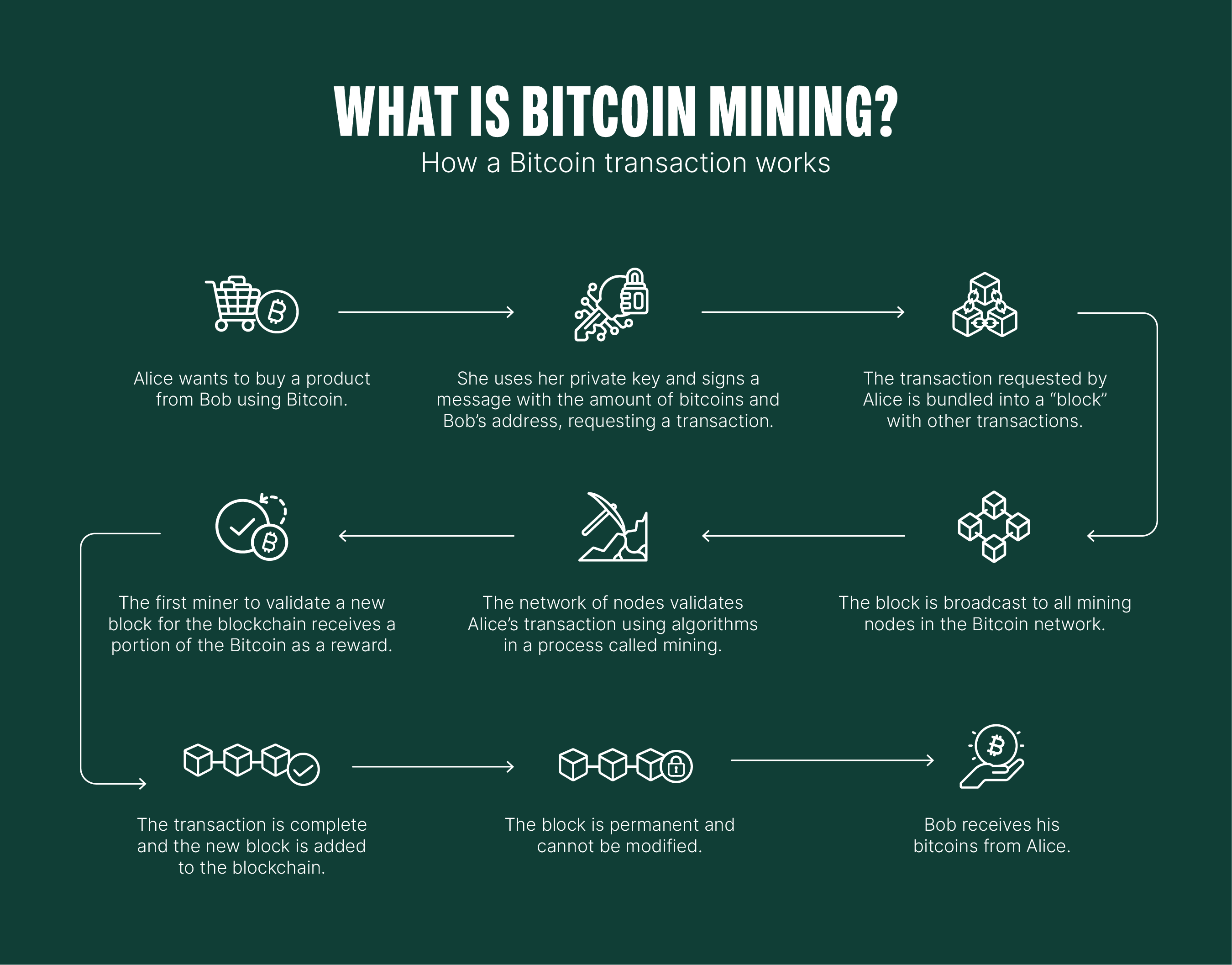
Bitcoin block rewards are a form of compensation given to miners for validating blocks of transactions on a blockchain, encouraging miners to solve the puzzle first. The bitcoin block reward as of early 2026 consists of a 3.125 BTC (which was halved in April 2024), plus transaction fees paid by the user. Block rewards essentially reward miners for their efforts in ensuring the operation and maintenance of the blockchain.
Block rewards started at around 50 BTC, but are cut in half approximately every four years, which is known as bitcoin halving. This means that rewards are now much lower compared to earlier years, and rewards will eventually reach zero, so miners will only earn fees.
Key aspects of bitcoin block rewards and fees include:
Transaction fees: Miners collect fees from all transactions in a block, which vary based on current network demand and transaction data size.
Total revenue (Block reward): Miners collect new BTC (currently at 3.125 BTC) plus total transaction fees as revenue.
If you want to learn how to start bitcoin mining, you will need the following:
New to Bitpanda? Get started today!
Sign up hereWhether bitcoin mining can be profitable depends on a few key factors.
When considering the potential block reward of successfully solving a puzzle (3.125 BTC plus transaction fees), you may also want to think about how the investment needed to earn this requires a lot of money up front, and the volatility of Bitcoin should also be taken into account.
To make bitcoin mining profitable, you would need:
Low electricity costs: Mining is very energy intensive, so electricity costs could diminish your potential returns.
Efficient hardware: While ASIC miners can be the most efficient, they are also costly up front.
A favourable geographic location: Since mining hardware can also overheat, it may be more beneficial for those living in cooler climates with lower energy costs.
It is also worth noting that since miners may be competing against industrial-scale mining farms, the costs to maintain a mining operation as a hobbyist might not be as profitable.
Being aware of potential risks of bitcoin mining is also worth considering when weighing the potential risks and rewards.
Risks of mining bitcoin include:
High energy consumption: Since bitcoin mining is an energy intensive operation, the environmental impact has raised concerns regarding sustainability and climate change.
Initial costs: Acquiring and maintaining specialised hardware for mining can be very costly, and inaccessible to many beginners.
Hacking risks: Hackers could inject malware to your hardware, which could spread to all connected devices, and use them to generate bitcoins themselves or other security breaches.
Regulatory uncertainty: The legality of bitcoin mining may vary across jurisdictions, meaning regulatory changes could lead to potential bans or increased taxation, affecting overall profitability.
Competition: The competitive nature of bitcoin mining against large-scale operations makes it difficult for new entrants to successfully validate transactions and solve puzzles first.
Bitcoin mining presents significant environmental concerns, primarily due to the energy intensive nature of the process itself. This is specifically due to CO2 emissions, but other key environmental issues related to bitcoin mining include:
High energy consumptions and carbon emissions: Bitcoin mining relies immensely on computing power, often generated from electricity, leading to large-scale CO2 emissions (estimated at 138 Terra-watt hours in 2025, or 0.5% of the world’s electricity consumption, resulting in 39.8 million metric tons of CO2 emissions).
Electronic waste: Hardware used for mining is short-lived, generating up to 30.7 metric kilotons of e-waste as of 2021.
Significant water usage: Mining operations often use water for cooling, leaving a massive water footprint, which can strain local water resources.
Bitcoin mining is legal in the UK and currently not subject to specific restrictions, but it is regulated under financial tax and property laws. This means miners must pay Income Tax or Corporation Tax on earnings, with large-scale operations considered as trading by HMRC. Operations must comply with general laws
Want to learn more about cryptocurrencies? In the Bitpanda Knowledge Hub, you’ll find a wide range of guides and tutorials explaining the basics, from the differences between a crypto broker and exchange to how to start trading cryptocurrency.
Here are frequently asked questions and answers about Bitcoin mining.
Disclaimer
Don’t invest unless you’re prepared to lose all the money you invest. This is a high-risk investment and you should not expect to be protected if something goes wrong. Take 2 mins to learn more.