You can use this formula to calculate whether a trade delivers a positive leverage effect or costs you more than it generates:
Return on equity = return on total capital + (return on total capital – cost of borrowed capital) × (borrowed capital / equity)
Legend:
Return on equity (ROE) or return on equity: your net profit in relation to your invested capital
Return on total capital (ROTC) or return on total capital: the return based on the entire position, including borrowed capital
Cost of leverage: includes daily fees, interest or funding rates on the borrowed capital
Which costs you need to consider when using leverage
In the crypto sector, the “cost of borrowed capital” usually consists of several fees that you should consider in your trading:
Purchase fees: apply when you open a leveraged position
Financing costs (or interest fees): arise when you keep a position open, though the intervals vary depending on the platform – on Bitpanda, they are charged every four hours
Liquidation fees: apply when your position is automatically closed because your margin is insufficient
Closing fees: apply when you manually close a leveraged position
These costs can reduce your return on total capital and therefore determine whether the leverage effect improves or worsens your return on equity.
Examples: how leverage amplifies gains and losses
An example is the simplest way to show how the leverage effect can influence your results:
You invest 1,000 euros of equity and use 5x leverage to open a position worth 5,000 euros.
If the price rises by 10%, you achieve an unrealised gain of 500 euros – this corresponds to a return of 50% on your invested capital before fees.
If the price falls by 10%, you incur an unrealised loss of 500 euros – that is 50% of your equity, also before costs are considered.
The price movement remains the same, but the impact on your equity is significantly greater. Please note: these gains or losses are only realised when you close your position or it is liquidated.
Requirements – when does the leverage effect work positively?
The leverage effect works positively when the return on total capital is higher than the cost of the borrowed capital used. This means your investment must generate more than the borrowed capital costs you. Only then does your return on equity increase through the use of leverage.
For a positive leverage effect to occur, the following requirements should be met:
The return on total capital is higher than the cost of borrowed capital: your position generates a higher return than you pay in interest and fees
Costs remain manageable: high financing costs can quickly offset the advantage of leverage
The market moves in the expected direction: price movements have a stronger impact on your equity due to leverage
As soon as the cost of borrowed capital exceeds your return, the effect reverses and becomes negative.
Risks of leverage trading
Whether you trade cryptocurrencies or other assets, you should always consider the risks of leverage.
Here are the disadvantages at a glance:
Because leverage amplifies price movements on your equity, your positions react more sensitively to price fluctuations
If the margin level falls below the required threshold, your position may be liquidated
Ongoing fees can reduce your returns
You should always monitor your positions and manage risk in a disciplined way (for example, by setting clear loss limits)
Leverage on Bitpanda
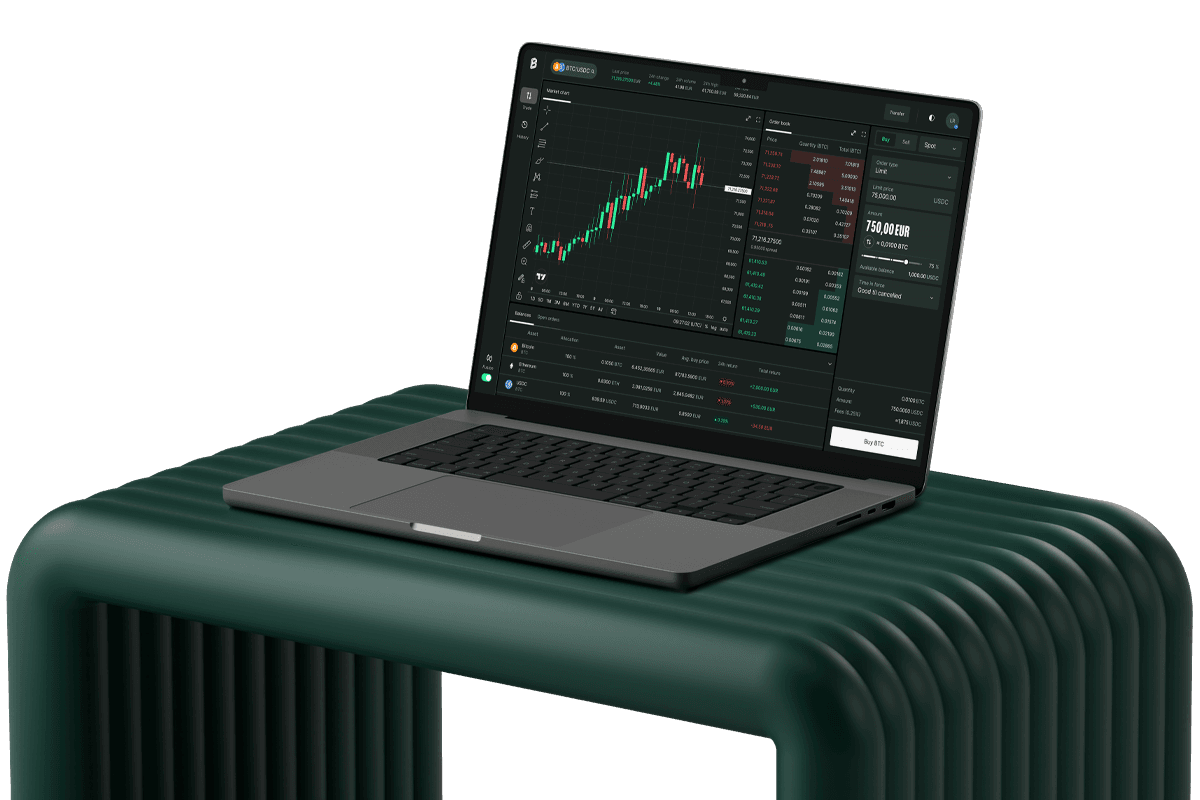
With Bitpanda, you can trade leveraged products directly on the platform – using borrowed capital and tailored to your strategy. Bitpanda Margin Trading* gives you access to more than 100 cryptocurrencies – with up to 10x leverage. You can take long positions, track your positions in real time and actively manage your risk. Liquidation alerts keep you informed. In addition, margin limit orders – including stop loss and take profit – give you even more control over your strategy.
If you want to use leverage without managing margin and risk yourself, Bitpanda Leverage offers leveraged tokens. These track the daily performance of an asset with a fixed leverage – such as 2x long or short – and are ideal for short-term market movements. You don’t need to provide collateral and don’t have to worry about liquidations. This gives you direct and straightforward access to leveraged trading.
Explore your leverage options with Bitpanda now and find the product that suits your strategy.